California leads the country in recycling infrastructure, waste diversion mandates, and environmental accountability — and the agency at the center of that system is CalRecycle. Short for the California Department of Resources Recycling and Recovery, CalRecycle oversees how the state manages solid waste from collection through disposal, setting the standards that every hauler, facility, and local government must meet.
For Woodland Hills residents and businesses in the western San Fernando Valley, understanding how CalRecycle’s framework shapes junk removal helps you hire smarter and dispose of unwanted items the right way.
What CalRecycle Does and Why It Matters Locally
CalRecycle administers California’s landmark waste diversion laws, including AB 939 — the Integrated Waste Management Act — which mandated that California cities divert at least 50 percent of their solid waste from landfills. Los Angeles has built an extensive infrastructure around that mandate, including transfer stations, material recovery facilities, and green waste processing sites that serve communities like Woodland Hills, West Hills, and Calabasas. Every junk removal job that leaves your property enters that infrastructure — or it should.
The agency also enforces California’s mandatory commercial recycling requirements under AB 341, which requires businesses and multifamily properties generating significant waste to arrange for recycling service. For Woodland Hills property owners managing estate cleanouts, office turnovers, or renovation debris, that requirement isn’t theoretical.
Hiring a hauler who sorts and diverts recyclables isn’t just environmentally responsible — it may be a legal obligation depending on your property type and waste volume. The CalRecycle agency maintains public resources on compliance requirements that property owners and haulers alike can reference directly.
How California’s Waste Hierarchy Shapes Responsible Removal
California operates under a formal waste management hierarchy — a priority order for how materials should be handled before disposal becomes the option of last resort. At the top of the hierarchy is source reduction: generating less waste in the first place. Below that come reuse, recycling, composting, and energy recovery — each representing a more responsible outcome than landfill disposal. Junk removal companies that operate within this framework aren’t just hauling; they’re actively sorting to divert materials toward higher-value outcomes.
For Woodland Hills residents clearing out a garage, completing an estate cleanout, or removing old furniture and appliances, this matters practically. A hauler that defaults to landfill for everything — regardless of the material — is operating below the standard California’s waste framework envisions. Usable furniture can go to donation centers.
Metal and electronics have dedicated recycling streams. Green waste from yard debris is composted at permitted facilities across Los Angeles County. The U.S. Environmental Protection Agency tracks national sustainable materials management data and consistently identifies residential cleanout waste as one of the largest divertible waste streams in the country.
E-Waste, Appliances, and Special Handling Requirements
California maintains some of the strictest rules in the country for electronic waste — commonly called e-waste — and appliance disposal. Under the California Electronic Waste Recycling Act, consumers pay a recycling fee at point of purchase for covered electronic devices, and those devices must be handled by certified collectors and recyclers at end of life. Televisions, monitors, laptops, and certain other electronics cannot legally be landfilled in California.
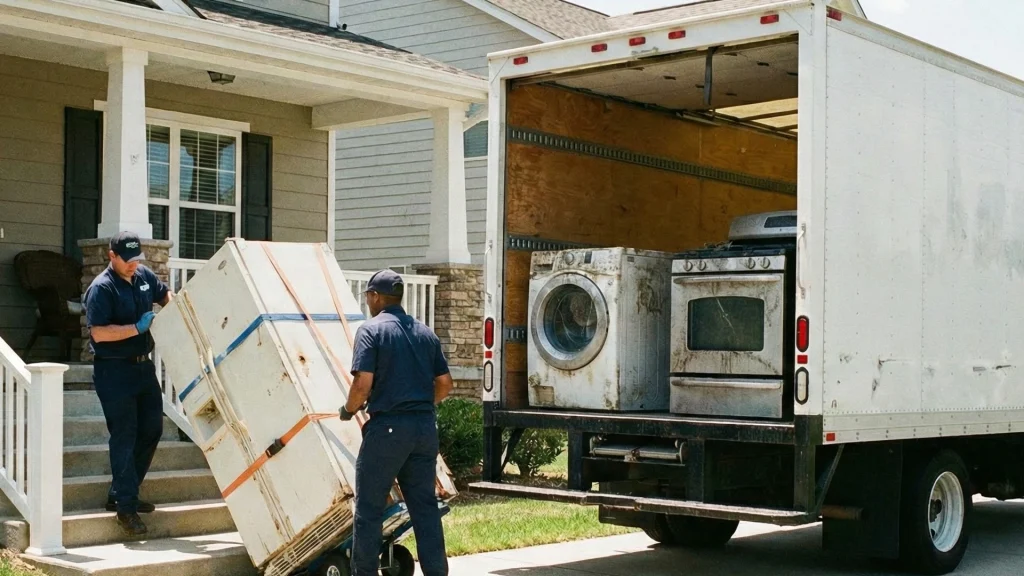
Appliances containing refrigerants — refrigerators, air conditioners, dehumidifiers — carry additional requirements under the federal Clean Air Act, which mandates certified refrigerant recovery before any appliance is dismantled or disposed of. A junk removal company hauling appliances in Woodland Hills without proper refrigerant handling isn’t cutting corners — it’s violating federal law.
That violation can create liability for the property owner if waste is later traced back to an improperly handled disposal. Asking a hauler directly about their appliance and e-waste handling process before booking is the fastest way to filter out operators who don’t meet California’s standards.
What to Ask a Junk Removal Company in Woodland Hills
Not every hauler operating in the San Fernando Valley meets CalRecycle’s expectations for responsible disposal. Before scheduling a pickup, Woodland Hills residents should confirm the following:
- Does the company sort materials for donation, recycling, and green waste diversion — or does everything go to landfill?
- Are they familiar with California’s e-waste requirements and do they use certified electronics recyclers?
- Can they handle appliance removal with proper refrigerant recovery documentation?
- Do they serve Woodland Hills and surrounding areas like West Hills, Calabasas, and Tarzana with consistent service?
- Will they provide documentation of disposal destinations if requested?
A company that answers these questions with specifics — not generalities — is operating at the level California’s waste framework requires.
Woodland Hills Junk Removal That Meets California’s Standard
Understanding CalRecycle’s framework gives Woodland Hills residents a clear benchmark for evaluating any hauler they consider. It’s not about being an expert in California environmental law — it’s about knowing enough to ask the right questions and recognize a compliant, responsible answer.
Malibu Junk Removal serves Woodland Hills and the broader western San Fernando Valley with exactly that standard in mind. From commercial junk removal and appliance removal to estate cleanouts and e-waste pickup, every job is handled with California’s waste hierarchy in mind — sorting, donating, and recycling wherever the material allows.
When you’re ready to clear the clutter the California way, contact us and let’s get started.